9/04/2025

Is butterfly bush invasive?

The Buddleja genus originated in central China and migrated across Asia and to the Americas, evolving into over 140 species as it spread. B. davidii, the most commonly cultivated species in our region, is a native of China.   

Buddleia davidii, produces copious seedlings and is invasive in certain parts of the country, particularly the Northeast and the Pacific Northwest. (See below map).  They don't spread in Iowa as far as I know.  (More info: https://www.brandywine.org/conservancy/blog/invasive-species-spotlight-truth-about-butterfly-bush 

There have been recent introductions to the garden markets of purportedly non-invasive or "sterile" Butterfly Bush. These plants have been bred to not set as much seed. If you simply must have a Butterfly Bush, these varieties may be an option. So if you want to plant butterfly bush - plant the non-invasive ones, just in case.
(Read more here: https://mgnv.org/mg-in-the-garden/are-butterfly-bush-cultivars-labeled-as-sterile-environmentally-safer/ )

Keep in mind - history is replete with plants touted as non-invasive that turned out to be just the opposite (case in point: multiflora rose). Eco-conscious gardeners would do better to opt for the native shrubs. 

Plant native shrubs instead including Sweet Pepperbush, also called Summersweet (Clethra alnifolia). For wetter soils, try Buttonbush (Cephalanthis occidentalis) or New Jersey Tea (Ceanothus americanus). 

You can also plant drifts of tall native perennials. Favorites of butterflies include Blazing Star (Liatris); Purple Coneflower (Echinacea purpurea); Giant Hyssop (Agastache); Joe-Pye Weed (Eutrochium) species and Milkweed (Asclepias) species.

If you already have Butterfly Bush as a planting, and do not want to remove it, you should prevent the spread out of your garden by REMOVING old flowerheads in the fall prior to seed dispersal. Do not dump clippings or flowerheads in natural areas or compost piles.  


Areas where Buddleia davidii is INVASIVE.


5/23/2022

Milkweed Yellows Phytoplasma

There have been a number of questions in the MEI group about phytoplasma, or "milkweed yellows'.

This is the best explanation I can come up with after an extensive search. It comes from this .pdf

https://monarchjointventure.org/images/uploads/mlmp/mlmp_update_2014_fall.pdf

Photo courtesy of Julie Ross, MEI member

Phytoplasmas are bacteria; they do not have a cell wall and are enclosed by a single membrane. They cause diseases in plants and are spread by insect vectors (primarily leafhoppers). 

Leafhoppers aren't the only insect that can spread phytoplasma, but most of the known vectors are in the insect order Hemiptera. Their piercing/sucking mouthparts allow them to feed on the phloem of plants, where phytoplasmas live. These phloem-feeding insect vectors can transfer diseases such as milkweed yellows phytoplasma by feeding on an infected plant, allowing an incubation period during which the phytoplasma cells replicate and eventually reach the insect’s salivary glands, and then moving to a healthy plant and injecting phytoplasma cells into it during feeding.

How do you know if your milkweed has a phytoplasma disease?
There are a few symptoms to look for, according to the Phytoplasma Resource Center found on the USDA Agricultural Research Service website:
- Phyllody—development of leaf-like growths in place of normal flower parts
- Virescence—development of green color in place of normal flower color
- Witches Broom—abnormal, excessive proliferation of axillary shoots resulting in a broom-like growth
- Yellowing—leaves lose normal green color, becoming yellow
- Little leaf—development of abnormally small leaves
- Proliferation—abnormal growth of numerous stems
- Necrosis—death of cells and/or tissues - Dieback
- death of branches
- Stunting—overall reduction of plant height
- Bunch top—shortening of internodes at and near the tip of a branch, resulting in bunched growth at the end of the branch

Photo courtesy of Julie Ross, MEI member

What should you do if you suspect phytoplasma in your milkweed patch?

Since the disease is spread by insect vectors, one way to get phytoplasma under control is to quickly and effectively eliminate any milkweeds suspected of phytoplasma, at the first sign of disease. By digging out an infected plant, you reduce the chances of other insects feeding on that plant and becoming vectors of the disease. 

Debbie Jackson, Monarch Watch Conservation Specialist, says ... 

Milkweed can be affected by a killer disease called phytoplasm. Signs: the leaves are wrinkled, like they're shrunken between the leaf veins, tissue near the veins is yellow, the plants are shorter and the stems are clustered too closely together than normal.

 - Please try to get all the root out to kill it. The entire milkweed planting may be affected because it is spread through the rhizome root system. You can't save part of it, you have to remove it all. The largest one I've seen was about 50' in diameter.

 - If you have monarch caterpillars to feed, you can dig it up, cut off the leaves, rinse & pat them dry, then refrigerate the leaves for up to 2-3 weeks to use for food.

Photo from Debbie Jackson
- The photo on the right is from my mom's garden in Marion, IA ....
pencil-thin stems packed together radiating from a node on the rhizome. 

 - Phyto kills milkweed and there is no cure. Leafhoppers suck up the disease and transfer it as they bite into other plants. Prevent it's spread by removing the affected plants. A friend of mine saw a clone of 200 common milkweeds die in 2 years from phytoplasm!

 - It has also been suggested to cover the milkweed plants with a mesh or tulle cover to avoid leaf hoppers getting to it and spreading the disease.


View more photos of phytoplasma at
https://squirrelworking.ca/plants/milkweed-yellows-phytoplasma/

You can also run a search for milkweed phytoplasma and then click "images" to see photos.

1/07/2022

2021 was a good year

Monarchs in Eastern Iowa members did a great job raising monarchs from eggs and caterpillars again this year.

Below are the 2021 totals as well as totals since we started in 2014. 

In addition, many of our members give eggs and caterpillars away to friends and neighbors to raise, and some of those people end up joining our group and getting in on the action!

Congratulations on another good year!


10/05/2021

A thank you

Monarchs in Eastern Iowa received an email from Rose, a student with the environmental club, OLSCA (Old Louisville Student Conservation Association, sent by a volunteer, Hannah, on her behalf.

Hannah wrote: Rose has been working on a project about how people interact with the environment, so she was doing research and ended up on the links page on this blog. It was a wonderful find because she was able to get some wonderful info from the sites on there & we're going to get a lot of use out of the links we bookmarked! She thought you might appreciate hearing how you helped us.

Rose also found an awesome page on photosynthesis for kids, at - https://www.lgcypower.com/solar-energy-and-photosynthesis/. It's a fun overview of the process with some vocab words. Rose was in charge of the plants this summer at her house, and she had the idea that we could include this in our thank-you note as a way of returning the favor! She thinks it's so cool how plants make their own food . She thought it would be a useful link for you, for other kids & students during this time, like us! Hopefully it's helpful!

 - Hannah and Rose

===================

THANK YOU ROSE!
It is wonderful to hear that you found our site useful. Best of luck in your research! And thank you, Hannah, for the volunteer work you do with OLSCA, which looks like a wonderful club!

All the best!
Barb, Monarchs in Eastern Iowa

1/11/2021

Think about your goals for monarchs

From Debbie Jackson,
Monarch Watch Conservation Specialist for Michigan and Northeast Region

There was an inquiry from Christine in PA in the Dplex forum through Monarch Watch to encourage monarch enthusiasts to rear 200+ monarchs in order to increase the population. I privately emailed her back that home-rearing to improve the population is not a feat that's possible; it would take 100,000 households to rear 100 successful monarchs just to get 1M and even Chip Taylor has stated this is not the goal, but to return available land to habitat.

The below response to Christine's message is from Dr. Chip's right hand , Angie Babbitt. We Conservation Specialists have deep respect for her as she's shown herself to be an educated and devoted person for monarch conservation. In the passage below, there are bullet points that are just the 'bomb'

Rearing monarchs for fun and education is not discouraged; to each his own. But restoring habitat as I'm seeing thru Monarch Research Project's plans (1000 Acres & 1000 Miles) is certifiably encouraged!!

Every way we can educate and reinforce the messages we know to be true is bound to help. It may be discouraging to some to think that rearing monarchs is helping but if we can gently guide their energies to more productive methods (these bullet points), the monarch community will thrive.

Warm wishes for a Happy New Year to you all! - Debbie


FROM ANGIE BABBIT, Communications Coordinator, Monarch Watch

(Edited to apply to Monarch in Eastern Iowa members)

Christine,
Thanks so much for your passion and your dedication to bring back the monarchs.  We are all working for a common cause, and that is to create a world where monarch populations and their miraculous migration can be sustained in the long term.  At Monarch Watch, we aren’t concerned that the monarch will be going extinct any time soon.  We are more concerned about extirpation – which is the localized elimination of monarchs, and the accompanying loss of the phenomenon of migratory patterns.  

Dr. Karen Oberhauser asked that I take a moment to respond to you.  I can’t speak directly for Karen, but Chip and I agree with her public statements:  rearing monarchs is enjoyable and is a wonderful way to connect with an insect that is in need of conservation, but rearing monarchs is not a conservation measure.  Monarch Watch does not discourage people from rearing monarchs, nor does Karen.  We also enjoy the process and appreciate that we may have kept some monarchs from being consumed by predators or parasites.  

However, rearing monarchs in large numbers can be problematic for the individuals because they are not exposed to 100% natural elements.  This is true of any animal that is raised in captivity, especially in large numbers.  Specific diseases that are normally flushed out by natural systems are prevalent in captive-bred or raised populations.  

One thing that isn’t often mentioned in these discussions is that monarchs produce large numbers of young which increases the prevalence of genetic changes, some of which are deleterious.  Genetic mutations are higher in organisms that reproduce quickly and in large numbers.  Think of the mutations that occur in organisms such as bacteria, which is how we end up with antibiotic-resistant bacterial infections.  Monarchs are much slower at reproducing than bacteria, but much faster than mammals.

You are right that there is a sense of urgency, and that monarch numbers may dip down below a threshold that may be difficult from which to recover.  Rearing hundreds of monarchs as an individual is not the solution to this problem, and multiplying that times many individuals is potentially making the problem worse.  

The “All Hands on Deck” approach does not include the home-rearing ingredient.  It can be a grass-roots effort, however.  I would encourage you to consider shifting some of your energy into other solutions that deploy the All Hands on Deck approach. This is not a fully comprehensive list, as there are many other options available: 

** Demand that rights-of-way are converted to pollinator habitat in a way that doesn’t have a negative impact on human health and safety.  You pay for these services, so you should have a say in how the land is managed.  This includes roadsides and utility easements. Back up your requests with information from:  http://rightofway.erc.uic.edu/

** Support a local pollinator garden at a school, library, church, etc.
   
** Petition your city commission to adopt policies that allow for the native plantings in yards. Back up your requests with information from the MJV Resources pages.

** Ask your municipality what chemicals they are using to control for pest insects, and find out if they are spraying for mosquitos rather than educating the public, encouraging larvicide (mosquito dunks) and standing water removal preventatives. If the municipality is using pyrethrin-based chemicals only, and repeatedly, they are not effectively controlling for mosquitos, but they are controlling for a lot of non-target insects.

** Provide others with resources for creating pollinator habitat, especially public spaces such as churches, schools, industrial complexes, etc.

** Lead a book club that explores books such as Bringing Nature Home by Douglas Tallamy.

** Encourage friends and family to consume locally-produced food, and try your best to do the same.  This cuts down on the energy that is needed to produce the food and also supports small farms.

** Do your best to drive less.

** Support businesses that have lower carbon emissions and are working on climate change solutions.

   
For those DPLEX readers who didn’t see this webinar, we invite you to watch it.
https://monarchjointventure.org/resources/monarch-webinar-series/research-reports-from-the-field-monarch-biology-and-rearing


I know that you feel like you are doing a good thing by raising multitudes of monarchs.  We all would like to believe that is a solution, but unfortunately, it falls short.

All the best to you this year.

Angie Babbit
Communications Coordinator
Monarch Watch
The University of Kansas, KS Bio Survey

9/13/2020

Keep your eye out

Thanks to Cassie M. for her photos of a roost near Lone Tree, Iowa

We are nearing peak migration, which is mid-September, for monarch butterflies traveling south through Iowa toward Mexico.  Monarch butterflies only migrate during the day. They come down at night and gather in clusters. A cluster of butterflies is called a roost or a bivouac.

Read more at Journey North - Why Do Monarchs Form Overnight Roosts During Fall Migration?

There have been several roosts of monarch butterflies posted in our group. 

 - At the Monona Butterfly Gardens in Monona, Iowa, Clayton County.

-  In West Des Moines, IA

 - Southeast of Lone Tree, IA

100s of monarchs were seen in a field that was being mowed in Ames, IA

 9/14 - hundreds of monarchs observed in a roost in Pella, IA

 Keep your eye out for monarch butterfly roosts in the early evening. You might get lucky!    


6/24/2020

Rear them right

Photo credit to members Mark and Janna from Marion.
Monarch butterflies are back in Iowa and our members are HAPPY to return to their routine of finding eggs and raising caterpillars into mature monarch butterflies. Many members have also increased their plantings of milkweed and native pollinator plants and are happy to start seeing the blooms.

Now is a good time to review the "best practices" for raising monarchs to be healthy and strong.

(Copied from a previous post quoting Monarch Watch.)

The migration to Mexico is a strong selective force.
It eliminates the weak ... those with diseases ... the undersized ,,, and those with genetic and other deficiencies.

It also eliminates those that have not received the environmental cues that properly trigger diapause and the orientation and directional flight characteristics of the migration.

BEST PRACTICES

1. Rear larvae under the most natural conditions possible.
"In other words, rearing outdoors, on porches, in pole barns, open garages, etc., would likely produce better results than rearing in an air–conditioned kitchen, spare bedroom or similar space."

2. Provide an abundance of living or fresh–picked and sanitized foliage to larvae.  ..."raising the monarchs on living plants–potted or in the ground–is likely to produce the largest monarchs, provided that the monarch larvae have an abundance of foliage to feed on at all times. Cut foliage in the form of leaves also works well, but the leaves have to be fresh and abundant relative to the numbers of larvae in each container."

3. Provide clean rearing conditions.
 ... Containers should be cleaned each day once the larvae reach the 4th instar.
 ... Foliage should be sanitized.

"To avoid passing the monarch disease Ophryocystis elektroscirrha (O.e. or OE) from outdoor monarchs to reared monarchs, both the living and cut foliage can be sanitized using a 10% bleach solution with a drop or two of liquid soap added. After soaking in the bleach solution for two minutes, the leaves should be rinsed thoroughly with clean water and patted dry before being fed to larvae."

"Living plants can be sprayed with the bleach solution and then rinsed. If you are using cut stems with leaves intact, they can be cleaned the same way. In that case, be sure to cut the stems under warm water before placing them in vases, etc. The warm water keeps the latex vesicles from closing down the transport of water to the leaves. Cut stems work to feed larvae, but they can go limp and be less suitable as a food source than cut leaves."

4. Plan the rearing so that the newly–emerged monarchs can be tagged early in the migratory season (10 days before to 10 days after the expected date of arrival of the leading edge of the migration in your area. [MEI NOTE: The leading edge in Iowa is around September 8th, so that would mean tagging August 30 through September 18th.]

5. Tag the butterflies once the wings have hardened and release them the day after emergence if possible.

Also, read and learn about "Monarch Annual Cycle: Migrations and the number of generations", a blog post from Chip Taylor of Monarch Watch.

10/05/2019

Linn County, Iowa - A place for pollinators

We who live in Linn County, Iowa are fortunate that we have a progressive program to develop pollinator habitat for monarchs and pollinators!  Please follow the below links to learn more!

From:  http://www.linncounty.org/1345/1000-Acres-Pollinator-Initiative
"The 1,000 Acres Pollinator Initiative is a public/private partnership in which Linn County Conservation, has partnered with the Monarch Research Project (MRP), Cedar Rapids Parks and Recreation, and the Marion Parks Department. This collaborative effort aims to restore 1,000 public land acres to a diverse native prairie habitat (Pollinator Zones) within five years through private funding. This primary goal is to restore significant monarch and pollinator habitat throughout the communities of Linn County, Iowa through a collaborative public/private partnership that engages governmental, business, educational, non-profit, and citizen sectors of the community."

  ..... In the first three years of the initiative (2017-2019), 802 of the 1,000 acres have been installed with a funding level of about $630,000 provided primarily by the Monarch Research Project through private donations and grants on over 400 acres on Linn County Conservation managed areas"


The Linn County 1,000 Acres Pollinator Initiative is a recipient of the 2019 Iowa State Association of Counties (ISAC) Excellence in Action Award, a competitive awards program that seeks to recognize innovative county government employees, programs, and projects. The awards were presented during a ceremony at the ISAC Annual Conference in Des Moines on August 21, 2019.


Also read about a 6.6 acre Orlan Love Prairie at Squaw Creek Park
“Orlan’s stories are credited with raising public awareness of the need to protect natural resources in Eastern Iowa and beyond the state’s borders,” the sign installed at the prairie reads, in part. “This prairie is a living tribute to a much-loved writer and conservationist.” From Homegrown Iowan

9/09/2019

Roosts in Iowa!

September 9, 2019 - The Journey North Monarch Roosts map is reporting roosts in or near the towns of Pleasant Hill, Rhodes, Dysart, Walcott and Manchester, IA. We are nearing mid-September "peak migration" for monarchs through Iowa!

If you see a roost, be sure to report it!  https://maps.journeynorth.org/map/?year=2019&map=monarch-roost-fall


Members from our group reporting roosts:

Cammie (near Whittier, IA) reports - Monarchs have been roosting overnight in my yard every night since September 1. Slightly surprised since last year I didn’t notice roosting until about mid month. Wednesday morning located approximately 93 with around 50 in one tree. This morning found about 45. I like to start stalking them around 6:30 and they typically will have trees picked out and settling down by about 7:30. Some will still come in around dark. Wind direction is a key in determining the chosen spot. AND -  Located approximately 100 this morning, Sunday September 8

September 8
Beverly from near Marengo
, Sept. 8th - I finally have a roost in my maple and mulberry trees. It was like walking in a dream. Hard to put a count on them. My tree was covered. Maybe a 750. The migrators are here!

September 11
Cheryl (northeast of Belle Plaine) saw a roost of 200 to 300
Julie in Davenport witnessed a small roost

Sept 12
Brenda, from Sutherland, had about 50 roosting
Kim, from Newton, 50+ monarchs - In all these years I’ve never seen Monarchs roosting! Today I did! Right across the street from my house. What an incredible experience.

Sept 13
Gwen in Deep River observed about 70
Linda, near West Branch saw a sizeable roost - Such a miraculous sight!

Sept 14
Renae, from Dunkerton - My back yard is full of monarchs!

Sept 15
Cheryl in Belle Plaine - Roost #2 this year for me! 6 pm 9/15/19 (in the middle of town)! These were everywhere! Was mowing late afternoon and noticed them flying around out back in the wooded area. They were not in huge groups but there were LOTS of groups of 4-30 in a group! They were even on the tall weeds! Guessing around 500!!! Every where I walked, Monarchs would fly! LOVE THIS!!!!

Jim from the Monona Butterfly Garden, Monona, IA - Monarchs have been roosting in and around Monona this week. Last night a roost of 650 was observed in the Monona Butterfly Garden. Tonight, we went down to count monarchs and found none. We saw only 3 monarchs all day. This may indicate the migration has moved south out of Northeast Iowa.

Scott, just North of Ankeny - My yard is being swarmed! Hundreds of roosting Monarchs tonight!

Sept 17, 2019
Jim (Monona Butterfly Garden) After two days with no monarchs roosting in the Butterfly Garden trees, an estimate of 700 tonight! Nectar source now is New England Aster and Macmillan Sunflower.

Sept 18, 2019
Jim (Monona Butterfly Garden) Many small groups of 10-75 total estimate tonight is 850. New England Aster is finally blooming and a big draw here. we even have them in our yard trees now.

Dave (Des Moines area) The migration is in full force in central Iowa. Yesterday late afternoon and evening I witnessed a continual stream of monarchs flying south 50-100 yards high. At a stoplight at a 235W entrance in Des Moines, around 4:30, I saw at least 50 streaming past in the short time waiting for green. They appeared to be traveling together, same height and following each other. Later I tagged 10 in a resting spot I accidentally located a couple weeks ago...in this spot I tagged 25 over 2 days 9/11-12.

Sept 19, 2019
Jim - Roost count tonight at Monona Butterfly Garden is 900. Note: first year since 2003 we have seen roosts over 100 and several of those years, there were no roosts at all. (2011 & 2012)

Read a Journey North blog about other amazing sightings
https://journeynorth.org/monarchs/news/fall-2019/09192019-amazing-year-eastern-migratory-monarch-population

Sept 20, 2019
Jim - My home very near the butterfly garden 110, Monona Butterfly Garden 1120, Friends house 350. Total roost count tonight from Monona is 1580..They are definitely on the move in large numbers. Our friend said the two hours earlier their roost was 3-4 times larger so some must have moved on.

Sept 21,2091
Jim - Total estimate this evening 1285 at the Monona Butterfly Garden and 335 in neighbors trees

Dave, Des Moines area - Saw 2 different roosts today, one I was invited to this morning, and one where we’ve been tagging monarchs...today more monarchs than the previous times by far. 100s...not sure how to even estimate the number.

Sepr 23
Cammie - NE of Marion - . Six large clusters of 100-200 and many smaller. Figured it would be a good day with the weather recently. They have been there all afternoon.

Dave - Des Moines area - If you get a chance to be outside today, look up..Monarchs pouring through central Iowa right now, likely the same throughout the state. Stepped on my deck and literally saw a dozen in a few minutes...soaring, circling ... all headed south...saw a similar amount driving a mile down the road for lunch. Enjoy!!

Jim -Butterfly Garden, Monona - Roost estimate is 1000 for tonight. The west wind slowed their progress. Monarchs were everywhere in town and large numbers crossing the highways in south and westerly directions.

Sept 24
Jim - Monona Butterfly Garden - 1400 tonight. strong SSW wind has slowed them down again. the monarchs are roosting significantly lower in the trees and shrubs tonight Roosting on the north and east sides of trees. Cannot remember ever having roosting monarchs for more than 4-5 days, it's almost 2 weeks now!!

Sept 25
Amy from Waterloo - Oh em geeeeeee.... I am stoked that I found these guys hanging out in our trees! I have no idea how to even estimate because they were lots of individual roosting spots all over our tree lines. I may or may not have taken a stupid number of photos of them!

Jim from Monona Butterfly Garden - could be the last monarch roost post this year, 1 roost of 60 monarchs in Monona at the butterfly garden. All the others are on their way to see you all on their way to Mexico.

Sept 26
Susan from Iowa City - My 4 year old and I counted 27 Monarchs in flight over a few MINUTES in the Iowa City area. Made my heart so happy! What we do makes a difference! (Other members also stated they saw monarchs in flight heading south.) 

Nancy from Central City - photographed a roost in her backyard.


8/13/2019

Fall events

August 13, 2019
I ran a search on Google, "2019 monarch butterfly events, Iowa". HOLY COW there are a lot of them!
  CLICK HERE for the results and find an event near you! Be sure to verify that the event actually IS in 2019!

8/07/2019

Best practices for tagging migrating monarchs

We have entered the time of the year that we are now raising the super generation of monarchs, those that will fly to overwinter in Mexico.

All members should thoroughly read this blog post from Monarch Watch. "Tagging wild and reared monarchs: Best practices"

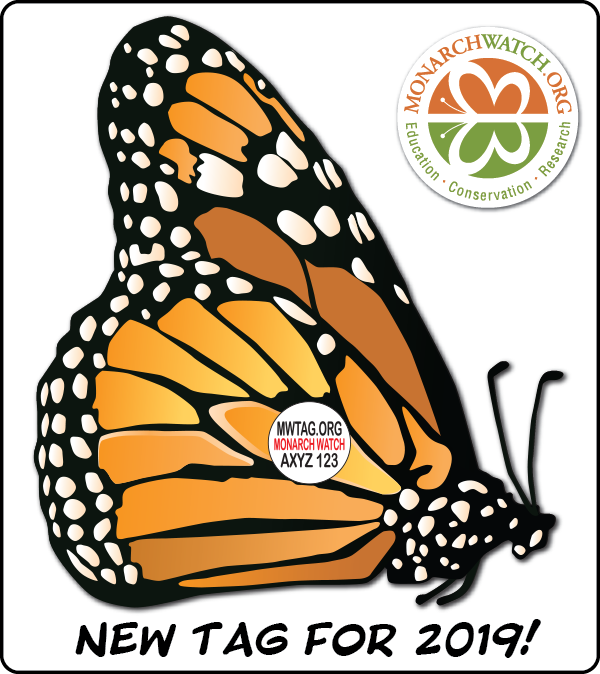
It contains information on the BEST practices for rearing successful migrators, and suggests you PLAN YOUR REARING so that the newly–emerged monarchs can be tagged early in the migratory season (10 days before to 10 days after the expected date of arrival of the leading edge of the migration in your area,  

The leading edge in Iowa is around September 8th, so that would mean tagging August 30 through September 18th.

Also MEI recommends that you plan to STOP collecting eggs/ and rearing by August 30th, preferably by mid-August. What is the use of raising monarchs that may not make it to Mexico? Or making them fly in temperatures that are just too cold?

I have attempted to break down the Monarch Watch post to make it a bit more understandable ..... good tips i
f you want your monarchs to make it to Mexico, tagged or not tagged!

EXCERPTS FROM THE BLOG POST:
"The migration is a strong selective force. It eliminates the weak, those with diseases, the undersized and those with genetic and other deficiencies

It also eliminates those that have not received the environmental cues that properly trigger diapause and the orientation and directional flight characteristics of the migration."

1. Rear larvae under the most natural conditions possible.
"In other words, rearing outdoors, on porches, in pole barns, open garages, etc., would likely produce better results than rearing in an air–conditioned kitchen, spare bedroom or similar space."

2. Provide an abundance of living or fresh–picked and sanitized foliage to larvae.  ..."raising the monarchs on living plants–potted or in the ground–is likely to produce the largest monarchs, provided that the monarch larvae have an abundance of foliage to feed on at all times. Cut foliage in the form of leaves also works well, but the leaves have to be fresh and abundant relative to the numbers of larvae in each container."

3. Provide clean rearing conditions.
"Containers should be cleaned each day once the larvae reach the 4th instar.

"To avoid passing the monarch disease Ophryocystis elektroscirrha (O.e. or OE) from outdoor monarchs to reared monarchs, both the living and cut foliage can be sanitized using a 10% bleach solution with a drop or two of liquid soap added. After soaking in the bleach solution for two minutes, the leaves should be rinsed thoroughly with clean water and patted dry before being fed to larvae."

"Living plants can be sprayed with the bleach solution and then rinsed. If you are using cut stems with leaves intact, they can be cleaned the same way. In that case, be sure to cut the stems under warm water before placing them in vases, etc. The warm water keeps the latex vesicles from closing down the transport of water to the leaves. Cut stems work to feed larvae, but they can go limp and be less suitable as a food source than cut leaves."

4. Plan the rearing so that the newly–emerged monarchs can be tagged early in the migratory season (10 days before to 10 days after the expected date of arrival of the leading edge of the migration in your area*).
MEI NOTE: The leading edge in Iowa is around September 8th, so that would mean tagging August 30 through September 18th.
5. Tag the butterflies once the wings have hardened and release them the day after emergence if possible.

6. When it comes to tagging, tag only the largest** and most–fit monarchs. "Records of tags applied to monarchs that have little chance of reaching Mexico add to the mass of tagging data, but do not help us learn which monarchs reach Mexico – unless the measurements, weight and condition of every monarch tagged and released is recorded. There are a few taggers who keep such detailed records and those data can be very informative. If you collect such data and are willing to share it please contact Monarch Watch; do not add this information to the standard tagging datasheet."

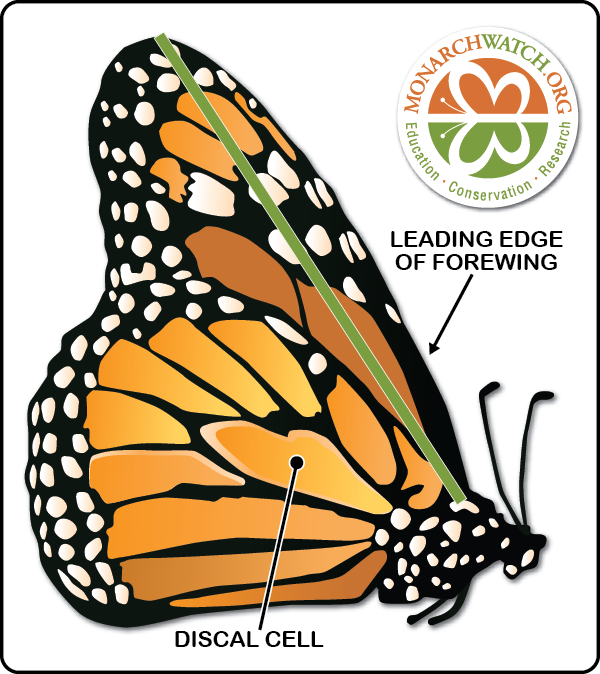
**The easiest way to judge the size of your monarchs is to measure the forewing from the base to the apex of the wing (Figure 1). These measures range from 46–52 mm with most migratory monarchs measuring 49–51 mm. After some experience with both wild and reared monarchs, it is relatively easy to judge those that are below 49 mm.


6/28/2019

An expert's opinion on rearing monarchs

This is a letter submitted to the Dplex-L email list by the Director of the Monarch Lab at the University of Minnesota, Dr. Karen Oberhauser.

The Dplex-L List is Monarch Watch's monarch butterfly discussion list.

Monarch Watch Conservation Specialist, Debbie Jackson asked that we post this to hopefully allay fears of those that are rearing/raising eggs or caterpillars from the wild.

This is in response to the recent study outlined in an article from The Atlantic, " Monarch Butterflies Reared in Captivity Lack a Crucial Ability"

From: Karen Oberhauser
Date: Wed, Jun 26, 2019 at 3:44 PM
Subject: [Dplex-L] Commercial and Indoor rearing

Dear All,

I'm going to add my thoughts to a long line of communication on the recent paper in PNAS about commercial and indoor monarch rearing and the resulting coverage. I was interviewed for several of the media reports on this article, and have thus received many messages about my message, at least as it was conveyed by reporters.

The most important finding of the paper in question is that monarchs reared in captivity for generation after generation become genetically distinct from wild populations, and at least in the commercial butterflies purchased for this study, did not exhibit migratory behavior. That is a problem, and a robust result of the paper. The fact that only one commercial stock was used means that the study needs follow-up, but it does show that long-term mass rearing can result in genetic change that has the potential to cause problems for individual monarchs that are then released into the wild, and potentially for wild monarch populations if there is interbreeding.

Large-scale mass rearing for multiple generations is very different from rearing monarchs in captivity that are collected as eggs or larvae, and then released when they emerge as adults. It is important to note that the inside rearing in the experiment was done in incubators in which temperature and light were carefully controlled; think of a big warm refrigerator with controlled lights. As a result, the monarchs were not exposed to any natural light or temperature fluctuations; the lights went on for 14 hours, and were then off for 10 hours. While the authors said that these are fall-like conditions, they aren't. In the fall, daylength outside is changing rapidly. Work done in my lab at the University of Minnesota showed that decreasing daylength was a key driver of diapause induction. In most inside rearing conditions, such as in people's houses and classrooms, there are windows and diurnal temperature fluctuations which provide exposure to natural environmental cues. I’m actually not surprised that the monarchs didn’t migrate after being in an incubator under constant daylength conditions.

The genetic aspects of the study were interesting and important, but the conclusion about risks of single-generation raising of wild-collected eggs and larvae has much less validity. In my opinion, what people are doing when they rear monarchs in this way has incredible educational, inspirational, and scientific importance. As Ilse Gebhart pointed out, we would not know what we know about monarch parasitoids without the citizen scientists who rear monarchs they collect as eggs and larvae. I would encourage everyone who does rear monarchs to report their findings to the Monarch Larva Monitoring Project (mlmp.org; look for Activity 3 in the monitoring section).

The key message from this study is that there is strong evidence that purchasing monarchs from commercial suppliers will not help monarchs, and it could cause harm to release those monarchs into the wild. In my opinion, the risks of commercial production outweigh the benefits. I have said that often, and this study provides documentation of one of the potential risks, genetic change that makes the monarchs less successful in the wild.

Thanks to everyone on this list for your clear dedication to monarch conservation, which I share.

Karen

6/12/2019

Summer raising and events

Monarch in Eastern Iowa members are happily gathering monarch eggs and caterpillars (we call them cats) from milkweed plants once again. Soon we will have a new batch of Monarchs to release to nature, where they will lay eggs and make more butterflies. 

THANK YOU NEW PI FOR YOUR GENEROSITY!

For the fifth year New Pioneer Food Co-op (New Pi) has generously donated cups in which our members can raise cats.


Carrying out boxes of containers from New Pi.
Genie from the Co-op said the following:
"I want you to know that the containers & lids are compostable corn “plastic.” They are not dishwasher safe. They are better for the environment than than straight plastic ones. With the oceans filling up with rubbish, I felt your merry band of butterfly enthusiasts would appreciate this detail.

I also want to mention that plastic containers would have been a $190 donation, but these were $600. We at the Co-op really appreciate what you are doing for the planet & our values align. Our Co-op community & leadership really pulled through with support. This is one of our top three investments for the year.


We at MEI are VERY thankful for the support of New Pi! 
 -------------------------------------------------------- 
In other matters, we are going to be participating in a couple upcoming events. We encourage you to come out, bring your kids, enjoy and learn!

FAIRFAX USA DAYS
Saturday, June 22nd, 8:00 am to 1:00 p.m.
near the Fairfax Public Library

The first is at the town of Fairfax during their USA Days. The Fairfax Monarch Project is sponsoring an area dedicated to monarch education as part of the street fair (near the library). Monarch in Eastern Iowa will have an information table, MEI member, Roberta, will be there with her magiscopes and milkweed and pollinator seedlings to share, Milkweed Matters will have a seedball making table, the Fairfax Girl Scout Troop will be helping, and Mike Martin will be there representing Monarch Research Project! There will be caterpillar adoptions, crafts and more.

MONARCH FEST, INDIAN CREEK NATURE CENTER
Saturday, July 13,  10:00 a.m. to 1:00 p.m.,

5300 Otis Rd SE, Cedar Rapids, Iowa 

This event is FREE and open to the public!  
MEI will be there with an information table as well as milkweed plants and pollinator plants to share with the public.

There will also be:
  Children’s crafts
  Milkweed seed ball making for Ragbrai riders
  Vendors
  Caterpillar adoptions (Limited number each hour, one caterpillar per family)
  Butterfly releases
  Educational presentations
  Popcorn and Honey Lemonade for sale featuring honey from Indian Creek Nature Center


3/08/2019

Upcoming events and here they come!

We try to post upcoming events of interest on our Calendar. Please click the "Calendar" tab above to view them and be sure to check back!

The monarchs are starting to leave their winter home in Mexico to fly north. Read this post from Journey North  -  "Here they come!"

Photo from Journey North

2/04/2019

Monarch Raising - yes or no

Please read information on the below link from Chip Taylor of Monarch Watch concerning the controversy on whether to raise or not to raise Monarch Butterflies from eggs and caterpillars.  

September 18, 2018
Monarch Watch Speaks Out About Raising Monarchs at Home


After you read it,  and as you make your plans for 2019, you may want to really think about ....
1) how many monarchs should you be raising

2) should you be raising monarchs early in the season and not into the fall migration? (stop collecting eggs/caterpillars by August 15)
3) think about raising the migrating generation outdoors to acclimatize them to natural conditions.
3) think about getting serious about checking for disease before release

4) think about changing part of your priorities to planting, planting, planting milkweed and pollinator plants. Especially pollinators that bloom in the autumn for migrating monarchs to fuel up on!
5) think about sharing your enthusiasm with friends and neighbors, schools, churches, clubs and organizations - especially about planting milkweed!


AND on another topic ... 
You may be interested in some of these upcoming webinars! Monarch Joint Venture has posted The 2019 Monarch Conservation Webinar Series 


12/04/2018

2018 Monarch Season Results

Thanks to MEI member, J. Ross, for the photo.
2018 has been a banner year for Monarchs in Eastern Iowa! 

Our dedicated members raised and released a whopping 21,036 monarchs from eggs and caterpillars this year.  This total surpassed the past 4 years (2014-2017) cumulative total of 18,321 raised monarchs. 

In the five years of our group's existence members have raised over 39,000 monarchs. This shows OUTSTANDING dedication and effort! This year we added 300 members bringing our total membership to 1400.

OTHER 2018 TOTALS 

Each year members voluntarily fill out information they have collected. Please note that not all members kept track of their activities.

 -
Number of monarch eggs, cats or butterflies adopted out to neighbors, friends, & classrooms - 1,927
 - Female monarchs released - 7,269 
 - Male monarchs released - 7,060 
 - Deceased caterpillars - 758
 - Number of monarchs tagged and released to fly to Mexico - 2,592

OTHER ACTIVITIES OF OUR MEI GROUP IN 2018

 - Meet & Greet joint meeting with the Muscatine Pollinator Project
 - Making milkweed seedballs at the EcoFest in Cedar Rapids for Milkweed Matters RAGBRAI initiative

 - Passed out info and free milkweed plants at Indian Creek Nature Center's Spring Plant Sale 
 - Helped sponsor a presentation, "The Monarchs are Coming", by Debbie Jackson, Monarch Watch Conservation Specialist, at Indian Creek Nature Center along with an information table.
 - Manned information and milkweed/pollinator plant give-away tables and volunteered at Indian Creek Nature Center's "Monarch Fest".  Harvested milkweed leaves from a local prairie and supplied caterpillars and eggs for the ICNC Monarch Festival as well as their children's programs throughout the season.
 - Information table at Fairfax, Iowa, Monarch Festival (put on by one of our members)
 - Encouraged members to register their growing area to be a Monarch Waystation (there were quite a few takers!) 
 - Many presentations, slide shows, and talks by members to groups and in classrooms.
 - Helped harvest milkweed for "Milkweeds for Monarchs", a project of Monarch Research Project
 - Held a milkweed and pollinator seed exchange in the fall in Ely, Iowa, for members and the public.
 - Facilitated several presentations about Monarchs in Mexico by Ellen Sharp, Cultural anthropologist, who lives at the entry of Cerro Pelon, a Monarch Butterfly Sanctuary in Mexico, and is co-owner of JM Butterfly B&B and director of Butterflies & Their People, A.C.

Thank you, thank you, thank you all for supporting our beautiful monarchs as we look forward to the new year!  Plan to PLANT MORE MILKWEED & PLANT MORE POLLINATOR PLANTS for 2019!

10/12/2018

Winter planting - milkweed and perennial seed

Thanks to Nancy Mast for the photo.
Many of our members collect milkweed seeds from a variety of milkweed as well as seeds from native perennial plants that provide nectar for monarch butterflies and other insects (such as new england aster, liatris, coneflowers, bee balm, ironweed, etc.).  They also save seed from beneficial annual plants to replant in the spring.

Milkweed and many perennial seeds can be directly planted in the ground in late October or November, after the soil temperature is below 50 degrees. The Iowa State Extension publishes soil temperatures at
http://extension.agron.iastate.edu/NPKnowledge/soiltemphistory.html

Ground temperatures in Iowa are now (October 12th) under or near 50 degrees, so it is time to think about winter planting either in the ground or in containers.

In the spring when conditions are right, the seeds should sprout and grow. What could be easier? There is no need to cold-stratify the seed.  Mother Nature does it for you!

Please click to read more about winter planting!
https://monarchsineasterniowa.blogspot.com/2016/11/winter-sowing.html


STRATIFICATION

If you don't winter-plant your milkweed or perennial seed and are saving it for spring, or saving it to share with others, you will need to cold-stratify them (put them through a period of cold).  Click on this link from Prairie Nursery in Wisconsin for a good explanation of various methods of stratification as well as a chart showing many plants and what treatment they need.
https://www.prairienursery.com/resources-and-guides/seeds-and-seed-mixes/documents/seed-propagation.pdf

For a list of Monarch Nectar Plants, see the Xerces Society chart (scroll down)
http://www.xerces.org/wp-content/uploads/2016/10/Midwest_Monarch_Plant_List_spread.pdf

8/27/2018

Here they come!

Monarch butterflies are heading south.  Below is a link to the map that shows monarch roosts that were reported from various states.  
https://maps.journeynorth.org/map/?year=2018&map=monarch-roost-fall

Please report YOUR sighting to Journey North by finding the "Report Sighting" button on the above link.


8/21/2018

Is tropical milkweed harmful in Iowa


Asclepias curassavica (tropical milkweed)

From Debbie Jackson, Monarch Watch Conservation Specialist
"So many people are hearing tropical milkweed (Asclepias curassavica) is harmful to monarchs and the migration. It is - in SPECIFIC locations.  It is certainly NOT harmful in Iowa or states that get frost.  Dr. Chip Taylor was asked his opinion on the matter and here is his response."
Dr. Chip Taylor

I’ve been asked by several people to comment on some recent research on Asclepias Curv that has gotten a lot of press.

Here is an example. More bad news for Monarchs - Study shows climate changes devastating effect 

I want to make it clear that I have NO issue with the science, but have distinctly different take on the interpretations and implications of the study.

First of all, A.c., per se, is not bad for monarchs. It’s their ancestral base. It’s the dominant milkweed throughout the tropics and both it and monarchs occur in regions with extremely hot climates. Monarchs use A. c. in central AZ which is about as hot as it gets. If future climates are as hot as AZ in most of the monarch range, there will be few milkweeds of any species and virtually no monarchs. People aren’t putting any of these studies into the larger context - either at a continental scale or in view of future climates.

A.c. gets a bad wrap - partly because it’s not native, partly because it grows all winter along the Gulf coast such that multiple females bearing O.e. spores visit the relatively few plants available thus depositing spores on the leaves in the process of laying eggs. That dynamic has the potential to increase the incidence of O.e., which does depress the population. That said, the easy solution is to cut the A. c. back to the ground twice a year at critical times. If A.c. was well established and abundant along the coast, it would be one thing, but it is almost exclusively found in gardens and quantitatively is a TRIVIAL component of the collective populations of milkweeds.

Looking at this in the context of plant/insect dynamics, the responses of milkweeds to increased temperatures and CO2, as well as stress, which can change the amount of toxins in the plants, the amount of latex or the nutritional quality, are all part of the monarch’s world. Monarchs already deal with a broad spectrum of milkweeds species which vary greatly in their toxicity, responses to stress, latex production, nutritional quality and rates of senescence, etc.

For me, the bigger issue is maintaining the migration itself. With that perspective, and with my eye on future climates, I see all of the issues involving A.c. as distractions from what we should be paying attention to, namely, that we are loosing 1-2 million acres of habitat each year - mostly due to development (at present). Unfortunately, our restoration efforts aren’t keeping pace with those losses. We are losing the battle - this year’s large population notwithstanding.

Here is another point, more obscure, and I won’t explain all the details, but I’m speaking from data, the impact of planting A.c. varies greatly across the latitudes and especially the longitudes from the Rockies to the east coast.

At best, we should be using the concerns about A.c. to leverage the planting of native milkweeds without sending the message, since some people are not very discerning, that all milkweeds are bad - and yes, some people are reacting in that way. Negative messages generally don’t work and haven’t been terribly effective in cutting down the planting of A. c.

We need a more positive approach to how we engage the public about this species.


8/16/2018

Upcoming monarch activities

Three chances to hear Dr. Ellen Sharp speak about Monarchs and some upcoming Monarch Festivals in the area.

Hear Dr. Ellen Sharp ....

1.  Saturday, August 18 -1:00-4:00pm
Monarch Conservation in Mexico, Dr. Ellen SharpWickiup Hill Outdoor Learning Area, 10260 Morris Hills Rd, Toddville, Iowa
Hosted by Linn County Conservation - Wickiup Hill Outdoor Learning Area
https://www.facebook.com/events/242060019744165/

     Many people in the U.S. and Canada are passionate about protecting North America’s monarch butterfly migration, but what happens once the monarchs reach their overwintering grounds in Mexico? This talk will provide an overview of Mexico’s official conservation efforts and the on-the-ground reality of what ordinary Mexicans are doing to help this fragile phenomenon to survive.
      Dr. Ellen Sharp is a cultural anthropologist who lives in a tiny town at the entry of the Cerro Pelon, a Monarch Butterfly Sanctuary where she and her husband run an ecotourism business. There is no cost for the program. Donations welcome.


2.  Sunday, August 19 - 10 am 
Monarch Migration, Iowa to Mexico, Dr. Ellen Sharp
Reno Park, Goose Town, Iowa City


 3.  Monday, August 20 -6:00pm
Monarch Migration, Iowa to Mexico, Dr. Ellen Sharp

Indian Creek Nature Center, 5300 Otis Rd SE, Cedar Rapids, Iowa
Please register for this event at  https://docs.google.com/forms/d/e/1FAIpQLSe7OCtrUAmE2oTTw2WVJkD0oc0tBxe6CmlwFax1Of093P2yLA/viewform


And festivals!

Sunday, August 26 -1:00 to 3:00 pm
 Iowa City Monarch Festival

The Festival will be held at Terry Trueblood Park Lodge,

579 McCollister Blvd, Iowa City.
This event is free to participate and open to everyone. In previous years, folks have enjoyed family-friendly activities, games and crafts, along with a photo booth and lots and lots of learning displays and handouts about the Monarch butterfly

https://www.icgov.org/ICMonarchs#Iowa%20City%20Monarch%20Festival

Saturday, September 8 -10:00am
Monarch Migration Festival   

Lakeside Nature Center, 1033 S Lake Storey Rd, Galesburg, Illinois 61401
Monarch Butterfly and Pollinator Education / Conservation and Activities for all ages. Find posters and more on website:
http://go.illinois.edu/MonarchFest

Facebook event:  https://www.facebook.com/events/1400330456742748/  


COMING THIS FALL! 
Monarch Zones and the Linn County Master Gardeners are sponsoring an event this fall and are asking for help from various groups (boy or girl scout troops, 4H clubs, church groups, employee groups and the like) to help harvest vast amounts of Milkweed Seed Pods. They will be added to the Milkweed Seed Pantry for the “2019 Milkweed One Million Seed Give-a-way.” Milkweed pods are usually ready to harvest from mid-September through October, but dates are dependent on weather, moisture and other acts beyond our control. They will provide instructions for picking and places to find the pods.

Read the flyer at https://drive.google.com/file/d/1bxe_ifA15BsrATeXPJ0d9aJneHrpCFU9/view
If you or your group are interested please sign up at the below link.
https://docs.google.com/forms/d/e/1FAIpQLSfbu0fsx6mQ-FSDGm5XGooN46Z96mw2qrLUwm7cm8f04MWDfA/viewform